Thank you to the Real Estate Department of the Budapest Chamber of Commerce and Industry and the Hungarian National Association of Real Estate Agents for inviting me to the October 16, 2026 “Compliance in Real Estate 2026” conference. As a MITOE board member, I appreciated the opportunity to speak alongside senior experts from Hungary’s tax authority, data protection authority, and consumer protection authority, as well as real estate and technology law specialists. I would also like to share the condominium-related lessons from my presentation with HázÜgyvitel readers.
A Professional Setting With Interconnected Fields
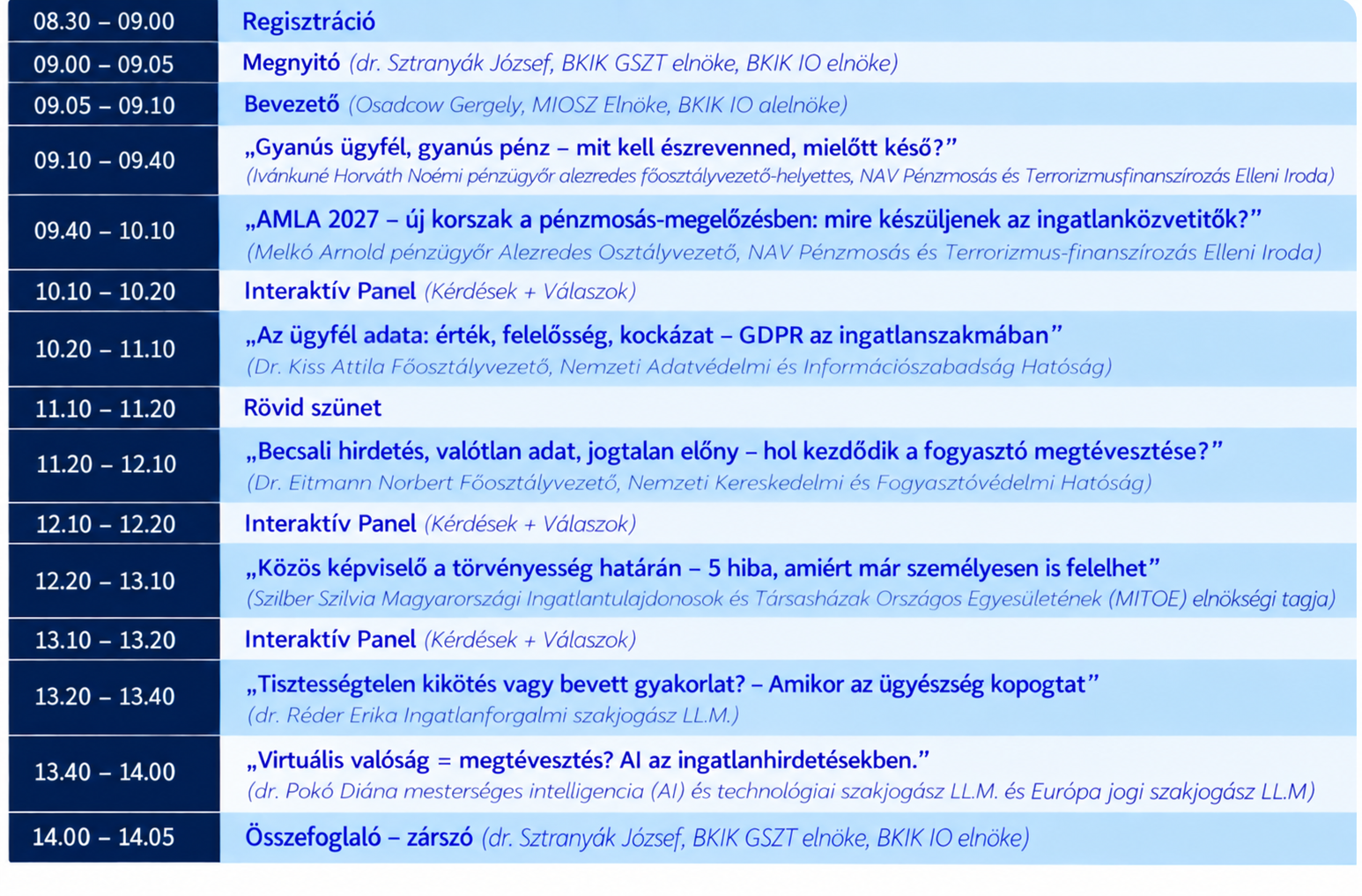
The official program Finance Guard Lieutenant Colonels Ivánkuné Horváth Noémi, Deputy Department Head, and Melkó Arnold, Division Head, represented the tax authority’s Office for the Prevention of Money Laundering and Terrorist Financing. Dr. Attila Kiss, a department head at NAIH, spoke about data protection, while Dr. Norbert Eitmann, a department head at NKFH, covered consumer protection. The program also included real estate law specialist Dr. Erika Réder and AI, technology, and European law specialist Dr. Diana Pokó.
For me, the value of this setting was the opportunity to present condominium matters within a broader operational context. Representatives, agents, and owners have different roles in a property transaction, but documents and information move among them. Clear responsibilities and accurate information matter at every point of cooperation.
Condominium Representatives at the Edge of Legality
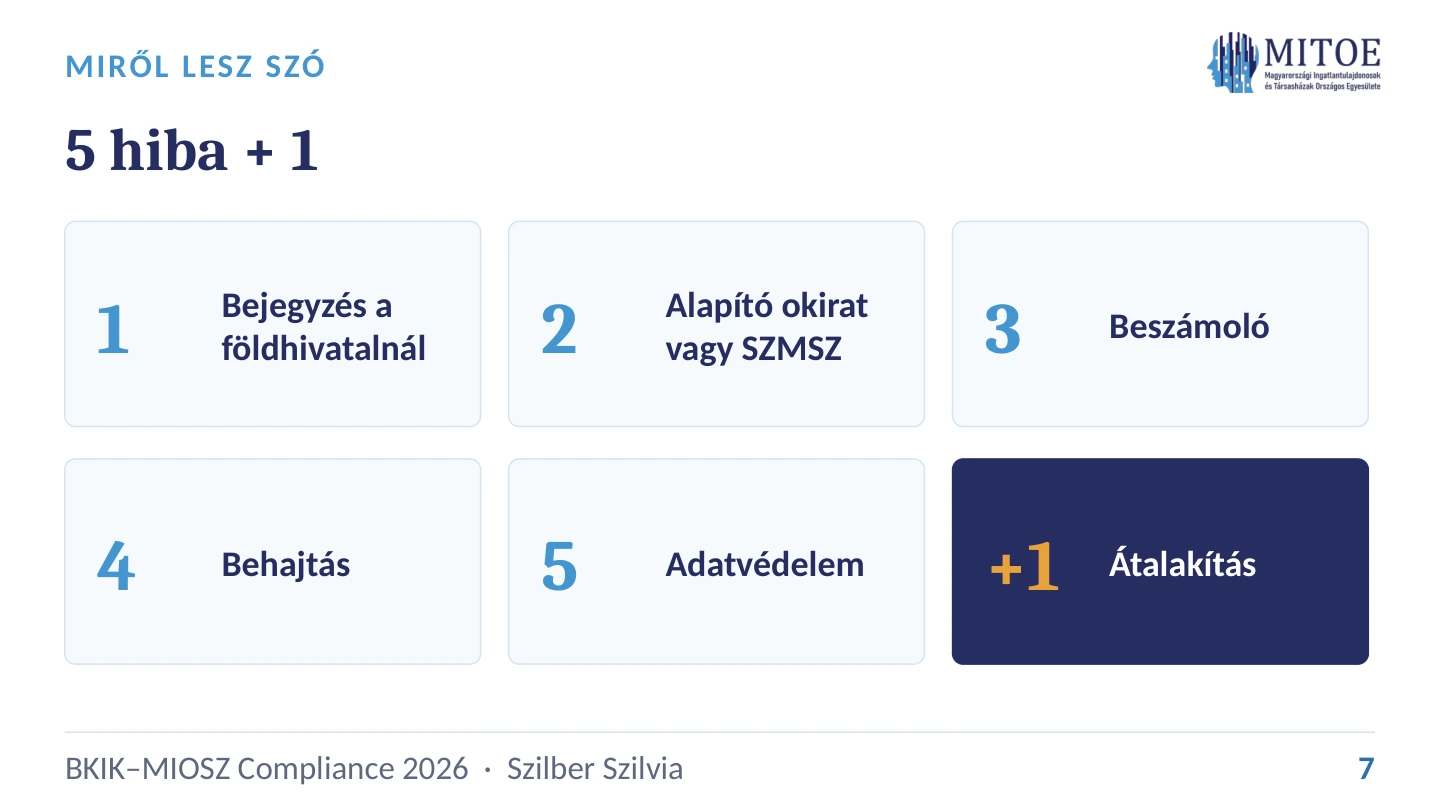
My presentation was titled “Condominium Representatives at the Edge of Legality – Five Mistakes That Can Lead to Personal Liability.” I began with a practical question: who bears the consequences of a missed action, and how can the condominium’s affairs be distinguished from the appointed representative’s responsibility?
Responsibility must be assessed against the legal relationship, the specific obligation, and what actually happened. A loss-making case does not by itself prove negligence. Diligent work must nevertheless be documented: when we learned of the problem, what action we took, who we informed, and what remained to be done. My presentation therefore focused on everyday decisions and verifiable case management.
1. Track Registration Separately for Each Building
The register of condominium officeholders and the register of professional condominium managers serve different purposes. Under Sections 55/A(2) and 64/A of the Condominium Act, the transitional ability to act without registration lasts until October 31, 2026. [1]
I emphasized the need to track each managed building separately. The appointment resolution, submitted application, and registration status must be retrievable. A submitted case needs monitoring through completion, or a missing step may come to light only later.
2. Read the Condominium Deed and Organizational Rules According to Their Respective Scope
I also discussed Kúria Uniformity Decision 5/2026. It clarifies the different matters governed by a condominium deed and by organizational and operational rules, and separately addresses buildings registered before the Act took effect. In an older building, one must examine whether a provision conflicts with mandatory law and whether a later decision or set of rules has replaced it. [2]
The practical task is to review the substance of the documents: identify the basis for allocating expenses, how communication is organized, and what must be prepared for the next owners’ meeting. Uncertain interpretations should be clarified with an attorney experienced in condominium matters.
3. Owners Should Understand the Building’s Position From Its Accounts
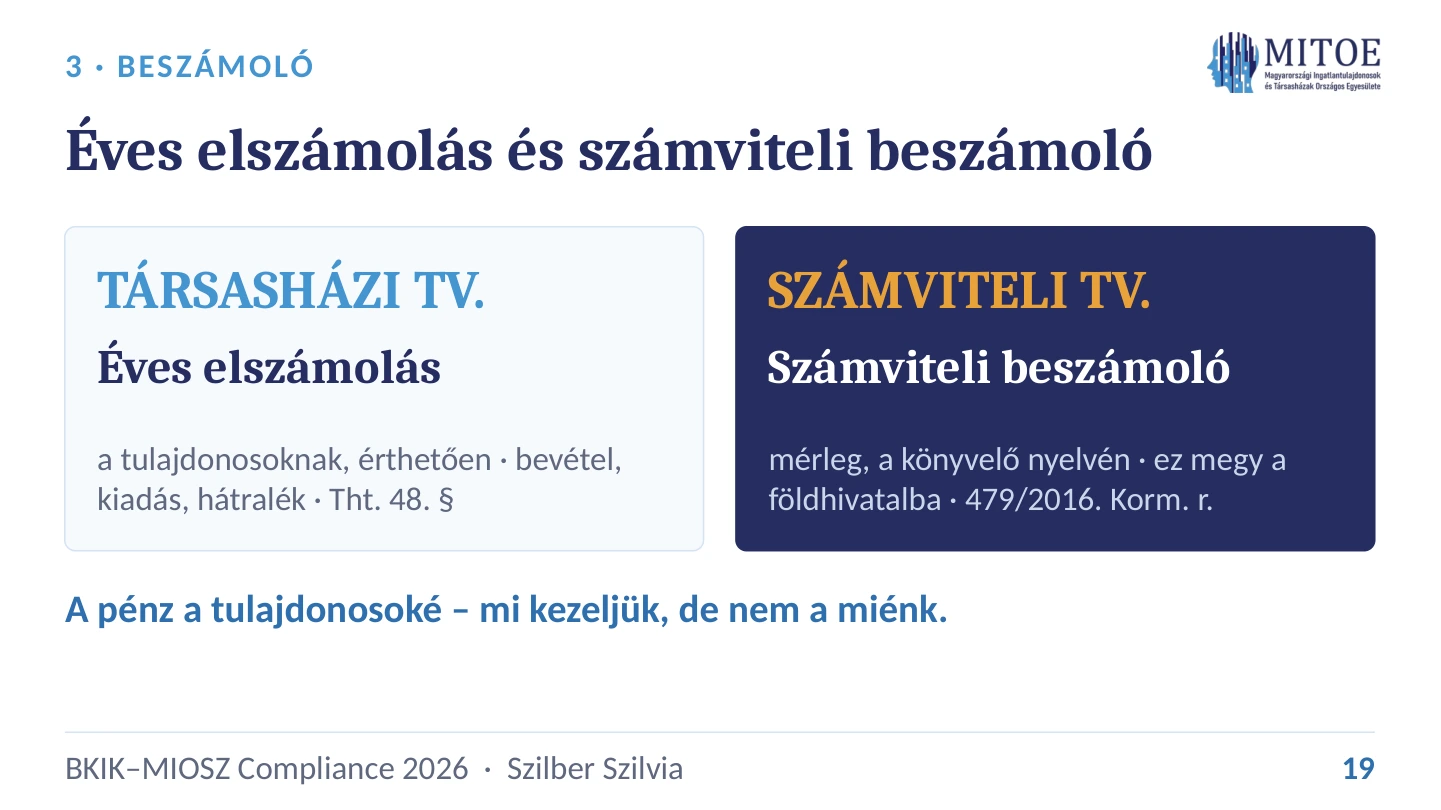
Distinguishing the annual accounts required by the Condominium Act from the accounting financial statements was another key topic. Section 48 sets out the content of the annual accounts, while Section 55/B(2) governs filing the approved accounting statements. [1]
In practice, financial reports should make cash movements traceable and show debts and collection actions. My examples included an omitted savings account and arrears disappearing from the list after a former owner sold an apartment. These require specific checks.
4. Every Arrear Needs a Next Action and a Deadline
Section 43(1)(c) of the Condominium Act includes collecting condominium fees and enforcing claims among the representative’s duties. [1] Recording arrears therefore needs a workflow that identifies who will take the next step and when.
I discussed the difference between an uncollectible debt and a failure to act. A manager’s work can be evaluated when the information behind their actions is retrievable. I also highlighted monitoring the liquidation of debtor companies, where specific procedural deadlines require professional input and accurate records.
5. The Actual Task Determines the Data Protection Role
My main data protection question was whose purposes the processing serves and on whose instructions it takes place. In the Kúria case discussed, the representative acted as a processor on the condominium’s instructions. This does not mean the same classification applies to every use of data for the representative’s own purposes. [3]
Document handover and the subsequent handling of data are part of ending an appointment. In practice, one must know where files are held, who has access, and the basis for retaining each document. A process agreed in advance supports consistent implementation.
One More Area: Alterations and Interfaces With Real Estate Agents
Under Section 1(2) of the Condominium Act, a load-bearing structure or shared-purpose installation can be common property even when located inside an apartment. [1] Alterations should therefore begin by clarifying which structures are involved and which procedures are required.
I also discussed written notices and the timely involvement of qualified specialists. Representatives must act within their authority and follow up on reported matters. Property transactions require similar care: establish the requester’s authorization and the information that may be disclosed.
Compliance Takes Shape in Daily Administration
For me, compliance means consistently applied rules and actions that can be traced. An organized process shows who owns a case, what happens next, and which document proves completion. I want to strengthen this approach through HázÜgyvitel because it makes condominium work verifiable.
Thank you to the organizers for their confidence, my fellow speakers for their professional perspectives, and the audience for their attention. I am pleased that practical condominium management questions were included in this professional program.
Sources and Professional Background
Event details, speakers, and program: BKIK – Compliance in Real Estate 2026. The program image comes from the BKIK event page.
[1] Act CXXXIII of 2003 on Condominiums, especially Sections 1(2), 43(1)(c), 48, 55/A–55/B, and 64/A.
[2] Kúria, Uniformity Decision 5/2026, on the respective scope of condominium deeds and organizational and operational rules.
[3] Kúria, Pfv.IV.20.340/2026/9., BH2026.152, on assessing the data processor role.
← Back to Professional Insights