After my trip to the United States and HOA and property manager training there, I first introduced the SzIM index at my March 18, 2026 Etikus Ingatlanosok presentation. An important part of the approach I brought home is managing a property together with its daily operations, financial performance, and long-term renovation needs. From that perspective, the building an apartment belongs to and the impact of its operations on the owner’s assets are particularly important.
I Brought Home a Broader Property Management Perspective
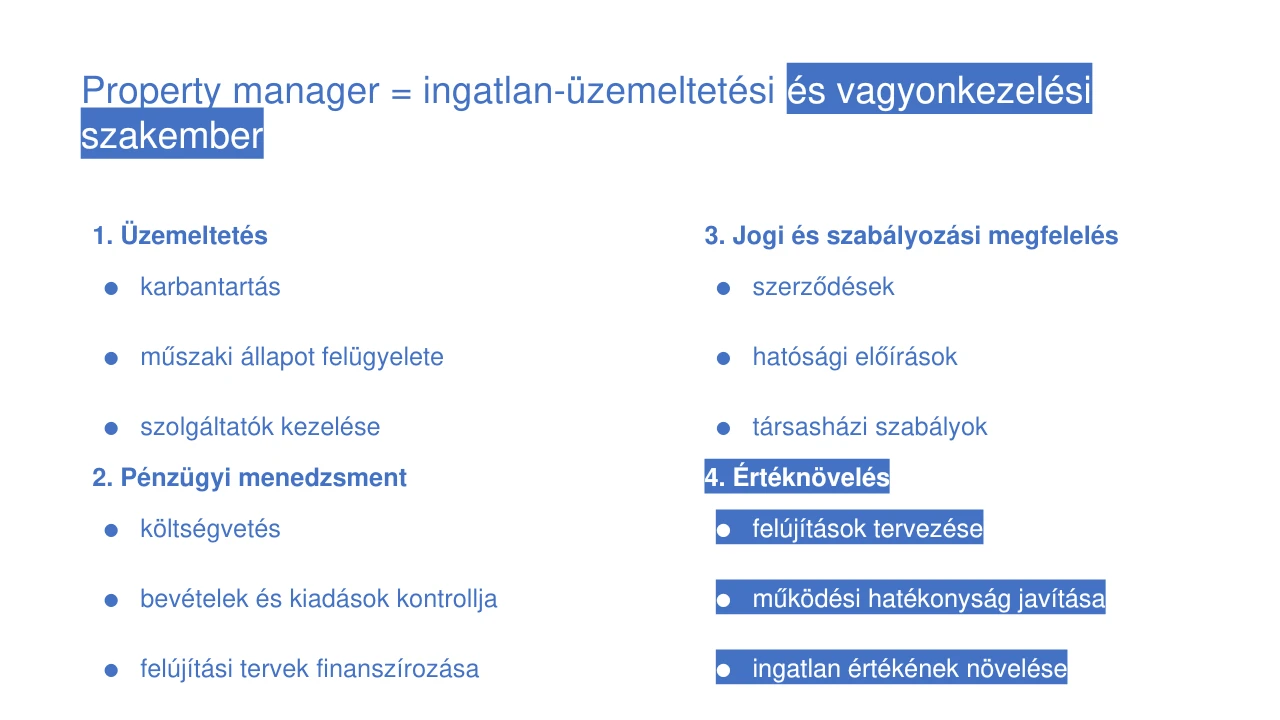
The approach was particularly instructive because investors often entrust the rental and management of individual apartments to professionals as well. Depending on the engagement, the work may include arranging rentals, communicating with tenants, tracking income and expenses, and preparing maintenance and later renovations. Owners often see the property as an income-producing investment and expect meaningful information about its performance.
Hungarian condominium practice often emphasizes current operations: fixing problems, paying bills, and organizing owners’ meetings. I want to strengthen an approach that considers the consequences for future years alongside today’s actions. How does maintenance influence later costs? In what condition, and with what financial resources, will the owner’s asset be preserved?
Within the U.S. system, managing an owners’ association and managing an investor’s individual rental units are distinct roles. An HOA, or homeowners association, concerns the owner community’s operations. Managing a rental apartment can be a separate appointment by an individual owner. The two meet in the building’s condition and expenses, while the client, decision-making authority, and reporting scope may differ.
“For me, the property manager’s perspective means operating the building while protecting the value of the properties within it.”
From the Speaker Notes for Slide 2.
From Rental Income to Results That Can Actually Be Planned
For an investor, the advertised rent is only the beginning. Vacancy, operating expenses, management fees, repairs, and financing costs also matter. Planning needs to include taxes and other obligations associated with the investment. Infrequent major expenses require particular attention, including equipment replacement or a substantial condominium renovation.
An owner who looks only at incoming rent may be caught unprepared by a later major expense. Financial planning needs to make monthly operations and longer-term investment needs visible together. Cash flow, accounting profit, and market value are separate questions, and each requires the appropriate assessment.
A deferred renovation of the common building can affect an apartment’s investment plan. An unexpected assessment reduces available cash, while a persistent technical problem may make the property harder to use or rent. The apartment’s management plan therefore needs to account for expected condominium work. Community interests and individual investment goals can be coordinated only within clear appointments and decision-making arrangements.
Why Does the SzIM index Focus on Condominium Operations?
It is relatively easy to start a conversation about an apartment’s condition. Gaining a consistent picture of the shared assets behind it is harder. I introduced the SzIM index to bring different kinds of condominium information into a structured assessment. The Index is the result of the assessment model presented: it helps identify stronger areas and those needing further investigation or improvement.
Results by category are at least as important as the total score. One building may have orderly finances but face major technical work. Another may need better documentation or follow-up on decisions. The same final score can therefore reflect different problems and different next steps.
The Documents Are Collected. Who Interprets Them?
“We also need to be able to interpret the completed property information file”
From the Speaker Notes for Slide 14.
This is an important sentence in my speaker notes. Collecting documents is the first step. Then we must recognize the connections: what funding supports the technical work, how far decisions have progressed, and what information is still missing. A structured assessment follows that interpretation.
These three steps require distinct work. A complete file can still contain unresolved questions. A score is meaningful only when we know which documents or answers support it. The reasoning behind the assessment should be traceable too.
Five Modules and 75 Questions in Total
“Each module contains 15 questions”
From the Speaker Notes for Slide 18.
The detailed audit examines five areas: physical and financial condition, governance, management, and owner-related operations. Fifteen questions per module produce 75 questions in total. In the method presented, scored answers lead to module results and then a weighted total.
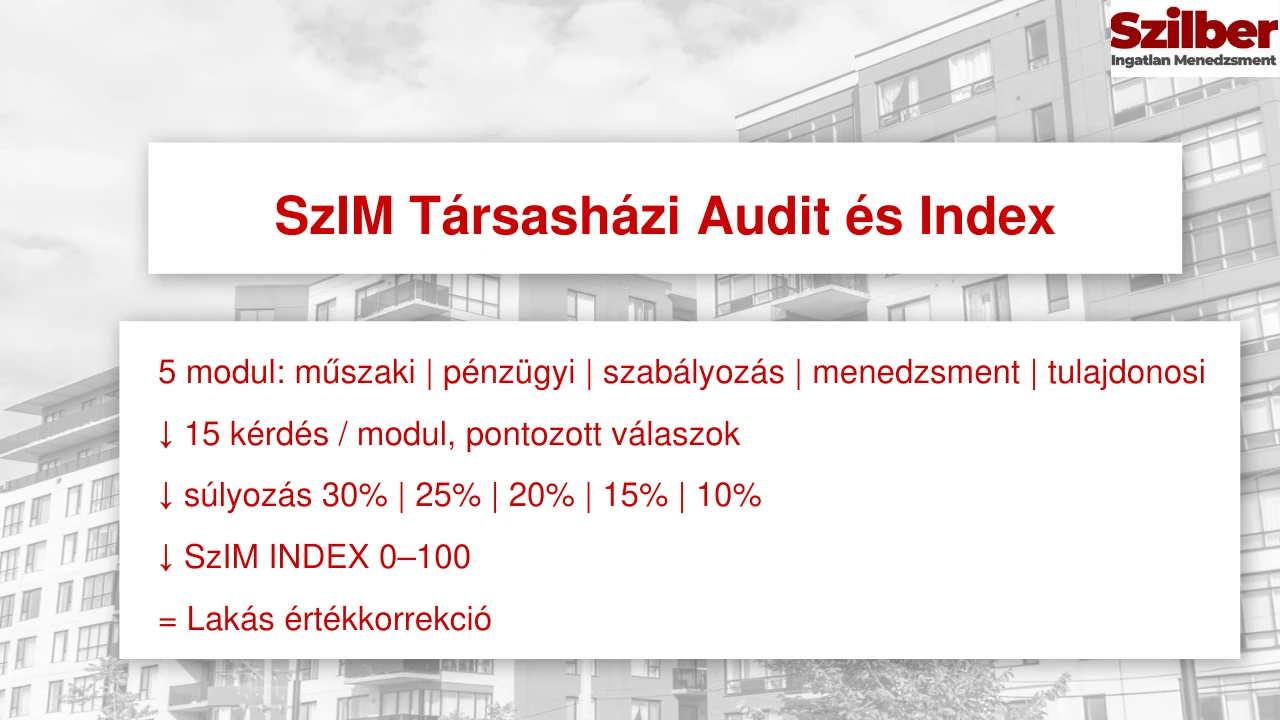
The slide assigned weights of 30% to physical condition, 25% to finances, 20% to governance, 15% to management, and 10% to owner-related factors. These are the weights of the model presented. The questions, scoring method, and available information jointly determine what the result means.
Owner-related operations should be assessed through cooperation and the community’s ability to make decisions. Observable operations provide the professional basis; individuals’ protected characteristics are not assessment criteria.
How Do the Modules Become One Index?
In the detailed model presented, each module result is multiplied by its assigned weight and added to the others. Consider an imaginary building scoring 60 for physical condition, 80 for finances, 70 for governance, 50 for management, and 90 for owner-related operations. With the slide’s weights, the total is: 60 × 0.30 + 80 × 0.25 + 70 × 0.20 + 50 × 0.15 + 90 × 0.10 = 68.5 points.
This example illustrates weighting; it is not an assessment of an actual building. Interpretation requires returning to the answers: why did management receive a lower score, and what supports it? That is the basis for an improvement plan. Missing information must be treated consistently under the methodology and disclosed with the result. Missing data does not itself prove a defect.
The Index is not an apartment’s purchase price, and 68.5 points does not mean a 31.5% loss of value. Price is shaped by the market and many transaction-specific circumstances. The Index can help organize assessment and decision-making by clarifying a building’s strengths and risks that need investigation.
The Ten-Question Quick Assessment Has a Different Depth
“10 questions”
From Slide 27 of the Original Presentation.
A later slide used this short description alongside a 0–100 scale. The quick assessment supports initial orientation: where should more detailed questions be asked? The five-module, 75-question audit provides a more thorough framework. The tools draw on different amounts of information.
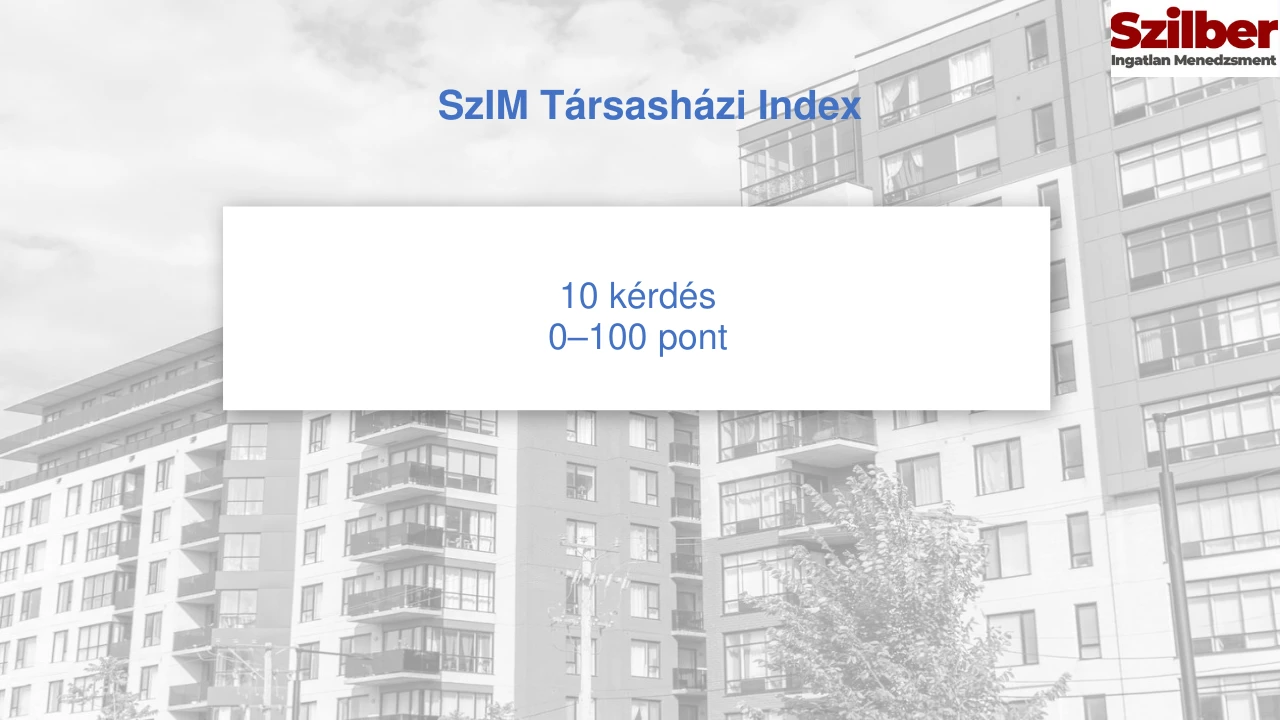
A reader given only a score may assume that two assessments of different depths offer equal certainty. Results should therefore identify the assessment type, date, sources, and missing information. Consistent methods and known conditions support comparability.
How Can the Result Help an Agent?
In the presentation, I linked the audit to professional arguments supporting a price and identifying expected costs. Agents can discuss a building’s strengths and areas needing further investigation more precisely. A score alone does not establish a particular price premium or loss of value; that conclusion requires separate support.
Neither the quick assessment nor the audit replaces a necessary technical, legal, or property valuation opinion. The methodology’s value lies in organized questions, traceable reasoning, and useful next steps for a decision.
The Assessment Becomes Practical Through a Renovation Plan
Identified technical needs must be connected to possible interventions, priorities, and planned funding. Distinguish work needed for safe use, asset preservation, and improvements that may enhance usability or rental potential. A return-on-investment analysis must not override necessary safety measures.
Investors can then ask about expected condominium costs before buying. The community can turn an assessment into improvement tasks and a trackable plan. Repeating it with the same method can show what changed, provided the sources and assessment conditions are comparable.
This is what I brought from the U.S. training to the Index: the apartment, the building, and financial management form a connected system. Careful management becomes visible through documented condition, a realistic financial plan, and tasks carried through consistently.
Thank you to Viktória Sándor and Gábor Kirsch for the opportunity to present this methodological development to the Etikus Ingatlanosok community. For years, they have created a setting where colleagues learn from one another as allies, strengthening the profession’s preparedness.
Professional Background on U.S. Roles
The The Community Associations Institute overview describes a community manager’s financial and operational responsibilities, including tracking budgets and reserve plans. A sample property manager job description published through the IREM professional community lists rental administration, annual operating and capital budgets, and financial reporting to owners together. The actual role always depends on the engagement and applicable local rules. The personal training experience and introduction of the SzIM index form part of my own account.
Source of the Quotations
This article draws on selected parts of my March 18, 2026 presentation. The source and slide number of each quotation are identified separately. The slides come from the original material. Learn more about the professional community on the Etikus Ingatlanos Website .
← Back to Professional Insights