Professional Profile · 2024–2026
· Updated: November 1, 2026
Szilvia Szilber’s Contribution to the International RenoInvest Project
Bringing practical Hungarian condominium experience into the European renovation debate
Successful condominium renovations require available technology to be matched with informed owners, a sound financing plan, and capable management. Szilvia Szilber brought this practical perspective to RenoInvest’s international work through her presentation, financing proposals, and contribution to the pilot study of the condominium at Rákóczi út 11.
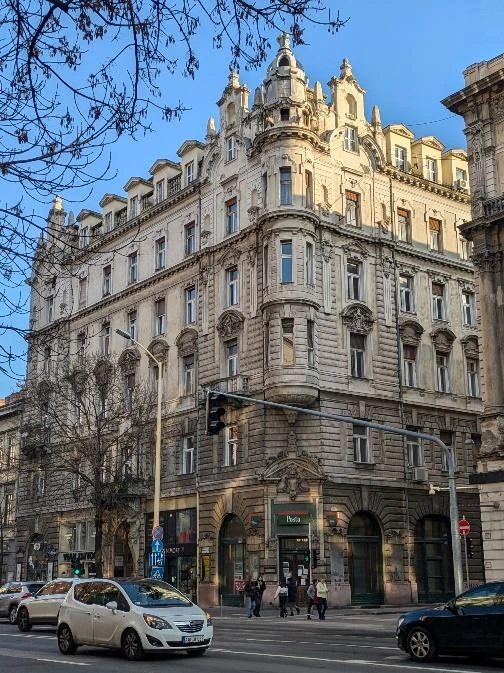
Photo: Dorottya Hujber, KTI [7]
One of the hardest challenges in improving building energy performance is turning technical solutions into investments that owners can approve and afford. In RenoInvest’s international discussions, Szilvia Szilber focused on the operational conditions that make this possible in a condominium.
The pilot study of Rákóczi út 11, a building managed by her company, highlighted both the scale of the necessary work and the financing constraints. The building offered a concrete setting in which renovation goals could be assessed alongside owners’ ability to pay, decision-making requirements, and management responsibilities.
01 / International context
What RenoInvest examined
RenoInvest was an international project co-funded by the European Union’s LIFE program. It aimed to identify barriers to renovation financing and develop practical measures that could bring more well-prepared building projects to implementation. The work drew on experience in Austria, Hungary, and Slovenia.
The Hungarian coordinator was ÉMI, whose responsibilities were subsequently taken over by its legal successor, KTI. The consortium also included Solar Tech-Investment, representing the Archenerg Cluster; Slovenia’s ZAG and Chamber of Commerce and Industry; and Austria’s RENOWAVE.AT and IIBW. The initiative brought together lenders, policymakers, technical specialists, and professionals with direct experience of operating buildings.
Alongside roundtables and working groups, case studies of selected buildings helped assess the proposals. Technical renovation concepts were examined together with investment costs, possible financing structures, and implementation barriers. This allowed the project to consider the relationship between energy goals and financial feasibility at the level of an actual building.
02 / May 16, 2024
Condominium experience at the financing table
Szilvia Szilber took part in the discussion at RenoInvest’s first Hungarian national roundtable. The event was held on May 16, 2024, at the Hungarian Banking Association’s headquarters at József nádor tér 5 in Budapest, focusing on opportunities for staged residential renovation.
She joined Réka Hámori, chief economist at the Hungarian Banking Association; Dr. Gyula Nagy of MBH Mortgage Bank; Dr. Ernő Nagy of Fundamenta; Ádám Dulfalvy of K&H Group; Gábor Szarvas of the Hungarian Green Building Council; and Lajos Vass of ÉMI. Ildikó Rajné Adamecz, financial expert at the Archenerg Cluster, moderated the discussion.
Condominium management experience drew attention to what financing proposals require in practice. Owners need to understand the work and its cost before approving a multiyear plan, while building up equity and preparing decisions also take time. These operational conditions affect feasibility just as much as the available technology.
03 / February 20, 2025
Invited to present the practical management side of renovation
Following the roundtable at the Hungarian Banking Association, Szilvia Szilber was invited to give a presentation at the February 20, 2025 event in Szentendre, addressing renovation from a condominium management perspective.
She also joined the discussion on developing renovation loan products for condominiums. The agenda placed her alongside Bernadett Dancsné Engler of OTP Bank, Réka Hámori of the Hungarian Banking Association, retired Budapest University of Technology and Economics associate professor Dr. Zoltán Magyar, energy specialist Péter Nagy, and ÉMI office head Norbert Ribai. Lili Béres moderated the panel.
The event’s professional summary devotes a separate section to Szilber’s presentation, emphasizing the role of long-term financial planning, owner awareness, and digitalization in preparing renovations. Its account of the panel also highlights her proposal for financial and energy education involving banks and public-sector stakeholders.
Original Documents
04 / The presentation’s practical framework
A functioning condominium is a prerequisite for renovation
Szilvia Szilber examined renovation in the context of the condominium factors that influence property value. She argued that physical condition, financial position, owners’ preparedness, internal rules, and management must be treated as an interconnected whole.
Modern technology becomes a completed investment when owners understand the task and can make decisions, financing can be planned, and management has the competence and commitment to organize and carry the project through. A missing condition can stall progress even when the technical solution is available.
Project preparation therefore begins with an assessment of both the building and its community of owners. Alongside the necessary work and its technical sequence, the assessment must consider reserves, future payment obligations, decision-making requirements, and gaps in the records. Management must coordinate these elements and help owners make informed decisions.
The presentation called for preparation that extends beyond the annual budget. The strength of a renovation reserve must be measured against expected investment costs, while creditworthiness can be improved through deliberate financial management, advance saving, and reliable information. The property information passport concept proposed organizing the building’s technical, legal, and financial records to support this work.
05 / The professional foundations of HázÜgyvitel
Digital management for financeable renovation projects
One of the presentation’s forward-looking proposals was a dedicated condominium management platform. Szilber described the connection of technical, financial, and organizational information as a way to support renovation preparation, project monitoring, and the assessment of financing risk.
The presentation linked the platform with cost tracking, schedules, documentation, and transparent communication. For owners, this can mean understandable tasks and decisions they can follow; for management, processes with clear responsibilities; and for lenders, more structured information.
The concept treated everyday case management and investment preparation as parts of the same operation. Maintenance records, outstanding technical tasks, and financial history can also become the starting information for the next major renovation.
This connects with the March 2026 letter of endorsement from Szilber Házak, published in RenoInvest’s public annex. The letter identifies HázÜgyvitel as a development aimed at digitalizing condominium operations and renovation management. Together, the presentation and the letter show the continuity between the proposed approach and the direction of development.
06 / The Hungarian condominium pilot
Rákóczi út 11 became an international case study
One of the most tangible parts of Szilber Házak’s involvement was bringing the condominium it managed at Rákóczi út 11 into the pilot study. RenoInvest’s public D5.1 report gives the Budapest building its own chapter, alongside Austrian and Slovenian cases.
Built in 1901 and situated in a heritage protection area, the building covers nearly 7,000 square meters and presents a particularly complex renovation challenge. In addition to the roof and building envelope, the concept considers heating, metering and controls, electrical systems, and the renovation of open-air access galleries.
Szilber Házak’s public letter of endorsement states that a detailed technical survey was carried out in a condominium it managed and that the process was treated as a pilot for examining policy and financing tools in practice. The international report also sets out financing scenarios for the renovation concept.
This contribution connected the project’s objectives with a real condominium. In an existing, occupied building, technical options must be assessed together with owner decisions, available savings, and the conditions for organizing the work.
Original Documents
07 / The financial barriers in numbers
The gap between investment needs and available equity
The Rákóczi út 11 analysis quantifies the difficulty of financing a comprehensive renovation. The full investment examined was estimated at approximately €2.76 million. The condominium savings included in the report represented just 3.55% of that amount.
The authors modeled three scenarios with different scopes of work. Alongside the full renovation, they assessed two narrower packages focused on energy savings. The models include an assumed grant component, the condominium’s own funds, and assumed proceeds from selling certified energy savings. These items do not represent awarded grants or financing agreements already in place.
Even with these assumed sources, the full scenario required debt financing of more than 83%. In the narrowest package, almost 69% of the investment still had to be financed through borrowing. The report concluded that a project of this scale did not offer a sufficiently workable solution using the sources available at the time and such a high debt share.
The study therefore considers combining substantial, targeted grants with long-term financing as a direction for further development. The case demonstrates why regular contributions to reserves must also be assessed in relation to the amount accumulated and the investment actually required.
| Scenario | Estimated investment | Debt share |
|---|---|---|
| Full renovation FM1 | €2.76 million | 83.51% |
| Reduced scope FM2 | €1.96 million | 76.82% |
| Narrowest scope FM3 | €1.47 million | 69.15% |
Source: RenoInvest D5.1, numbered pages 25–29. Figures reflect model assumptions from March 2026, with investment amounts rounded. The reduced-scope packages differ technically from the full renovation.
Original Documents
Source: [7]
08 / What the case study shows
Energy performance improvements must also address deferred building work
The building illustrates a difficult relationship within the renewal of Hungary’s existing housing stock. Energy upgrades in an older condominium often have to be prepared alongside roof, structural, or infrastructure work required by the building’s overall physical condition.
The Rákóczi út 11 concept connects roof renovation and insulation, facade solutions, heating and controls, electrical systems, and the structure of the open-air access galleries. For internal insulation, for example, the report calls for a separate moisture analysis. It also describes the need for a detailed organizational plan that allows the building to remain occupied during the work.
Deep energy renovation and a building’s complete physical renewal are distinct concepts. In a complex condominium project, however, they meet: improving energy performance must be coordinated with work needed for safe, durable use. The cost of that work cannot always be offset directly against energy cost savings.
The case therefore raises a fundamental financing question. What will pay for the structures and systems that require intervention when energy savings alone do not cover the full investment? In the report’s calculations, assumed proceeds from certified energy savings amounted to 3.51% of the full package’s cost.
The broader significance of this Budapest case lies in financing and organizational problems that are also relevant to other older condominiums. Szilvia Szilber’s contribution connects experience from everyday operations with long-term renovation planning.
Source: [7]
09 / November 27, 2025
Contributing to the Hungarian closing roundtable
Szilvia Szilber was again an invited participant at RenoInvest’s Hungarian closing roundtable. The November 27, 2025 agenda identifies her as a MITOE board member and managing director of Szilber Házak.
The panel on condominium renovation included Barbara Réthelyi, a department head at the Ministry of Energy; László Koji, president of ÉVOSZ; Réka Hámori, a director at the Hungarian Banking Association; Mónika Kurucz of K&H Group; and Edit Torda of Fundamenta. Dr. Róbert Gyárfás, Ilona Illésné Szécsi, Bence Kovács, Péter Nagy, and Gyula Szalai also appear in the participant list.
The event discussed the proposed action plan for condominium renovation. Szilber’s practical approach focused on the conditions for investments that owners can afford, finance, and organize. This perspective treats decision preparation and the capability of the management responsible for implementation as part of the renovation program itself.
Original Documents
Source: [6]
10 / January 13, 2026
Szilber Házak at the international closing event in Vienna
The third and final international RenoInvest roundtable was held in Vienna on January 13, 2026. The English-language event brought together the action plans of Austria, Hungary, and Slovenia and addressed the continuation of European cooperation on energy efficiency finance. According to Szilvia Szilber, Szilber Házak was represented at the event following the invitation.
The agenda includes European Commission expert Adrien Bullier, Austrian ministry official Andreas Rajchl, Hungarian financing hub chair László Bihari, and Slovenian policy official Erik Potočar. Wolfgang Amann of IIBW moderated the panel of national representatives.
Condominium renovation models were also a dedicated topic in the afternoon discussions. The event offered an opportunity to compare Hungarian experience with practice elsewhere. Szilber Házak’s work thus connected with cross-border cooperation focused on preparing and financing renovation projects.
11 / March 2026
Putting the project’s findings into practice
In its March 22, 2026 letter of endorsement, Szilber Házak committed to contributing to the practical use of RenoInvest’s findings. The focus is on applying condominium renovation plans and financial models and feeding operational experience back into the work.
The letter identifies areas of contribution in long-term financial planning for condominiums, one-stop-shop advisory services, renovation financing that combines grants and private funds, and training for condominium and renovation managers. It expressly refers to using lessons from the Rákóczi út 11 pilot.
The letter emphasizes solutions that can be applied in everyday operations. The proposed areas include putting renovation plans and financial models to work, improving decision-making, preparing financing, and systematically evaluating operating experience.
The reference to HázÜgyvitel links the international project with a digital development aimed at supporting condominium operations. The organizational and information gaps identified in the project highlight areas where consistently used case and document management can help in day-to-day work.
Source: [9]
12 / The practical value of the contribution
Why condominium experience matters to renovation feasibility
The core of Szilvia Szilber’s contribution was to assess the technical scope of renovation together with the way a condominium operates. She brought owner decisions, financial preparation, and management capability into the discussion as factors that determine whether an investment can be carried out.
In an occupied condominium, selecting the right technical solution must be followed by informing owners, scheduling tasks, and preparing financing. A community can make responsible decisions only on proposals it understands and that have a sound professional basis. Implementation then requires competent, motivated management and clear responsibilities.
The Rákóczi út 11 study gave this approach a concrete technical and financial setting. It showed how an older building’s renovation needs interact with accumulated reserves, owners’ payment obligations, and access to financing. These relationships help explain why technically justified upgrades may still not proceed and where the system supporting renovation needs to improve.
For homeowners and investors, this approach concerns the long-term usability and value of their property. The condition of shared structures, owners’ ability to make decisions, and the quality of financial management directly influence an individual apartment’s future. Professional work that treats these factors together underpins responsible asset management.
Szilvia Szilber brought this understanding of both the building and its community of owners to RenoInvest’s professional work. The development direction behind HázÜgyvitel serves the same task: turning well-organized daily operations into transparent preparation and traceable processes that can support long-term building renewal.
References
Sources and Original Documents
The article draws on primary project sources, organizers’ documents, and the author’s archive. Original agendas retain the names and positions listed at the time.
[1] ÉMI and Archenerg project introductions ↗
The LIFE project’s purpose, participating countries, consortium, and action-plan horizon.
[2] Archenerg’s report on the first Hungarian roundtable ↗
May 16, 2024, Hungarian Banking Association; the organizer’s account of the discussion.
[3] The first Hungarian national roundtable’s invitation and agenda ↗
The original event invitation, location, and preliminary agenda.
[4] The third national roundtable’s professional summary
February 20, 2025, Szentendre. Agenda on PDF page 3; the presentation summary on PDF page 9 and the panel contribution on PDF page 11. Original in the source archive.
[5] Szilvia Szilber’s RenoInvest presentation and speaker notes
Original presentation and speaker notes from the author’s archive. Sections used: slides 6–8, 10–13, and 16. The original deck is included in the source archive.
[6] Hungarian closing roundtable agenda and professional report ↗
November 27, 2025. The updated original agenda and the event’s professional summary.
[7] RenoInvest D5.1 Documentation on Pilot Cases ↗
Section 6.2.1, Rákóczi út 11, numbered pages 23–29, PDF pages 24–30. The investment and energy figures describe proposed scenarios.
[8] Official agenda of the third international roundtable ↗
January 13, 2026, Vienna. The agenda lists the announced speakers and panelists.
[9] RenoInvest public annex of endorsement agreements ↗
Szilber Házak’s March 22, 2026 letter on PDF pages 99–100.
[10] The February event’s preliminary announcement ↗
The event’s final professional summary is used for the final participant list.
[11] Szilvia Szilber’s account of Szilber Házak’s representation in Vienna
Personal statement concerning the company’s representation, November 1, 2026.
Images: ÉMI–Archenerg RenoInvest documents; Rákóczi út 11 photo: Dorottya Hujber, KTI; slides: Szilvia Szilber. Compiled November 1, 2026.